
Index important URLs in days, not months.
Quick Indexer helps SEO, Marketing, and eCommerce teams to push the right pages into Google faster.
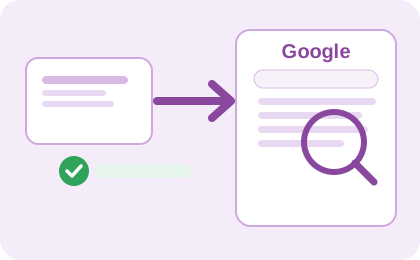
Quick Indexer helps you get your URLs indexed by Google and other Search Engines in a few hours. Do not wait for months, losing potential traffic.
For SEO Experts
We do last mile SEO. We bring Googlebot to visit your pages quickly.
Give us URLs or let us discover problematic URLs on your website. We index your URLs so most of them will be in Google by the next day.
For Marketers and Website Owners
Bring more customers from search engines to your website. Get more customers from Organic Search, spend less for paid Ads.
You might have a new website, all SEO features OK, but still you are not in Google Search Results, because Google did not come yet to crawl and index your website. We make Googlebot to come to your pages to crawl and index them quickly.
Why Choose Quick Indexer?
Our service is designed to be fast, reliable, and easy to use, making it the perfect solution for website owners looking to improve their search engine visibility.
- Google indexer that simply works!
… see our reliability - We are transparent, no black box, we explain you, how it works!
… see how we can bring Googlebot to your pages - You pay only for successful operations, you consumed.
Quick Indexer: How to Get Key URLs Indexed by Google in Hours, Not Months
In today’s fast-moving world of digital marketing and search engine optimization (SEO), time is one of the most valuable resources. You can create high-quality content, launch a new e-commerce store, publish hundreds of optimized landing pages, and invest heavily in technical SEO, only to discover that your pages are still missing from Google’s search results.
One of the reasons is simple: Google has not discovered, crawled, or indexed your URLs yet.
For businesses that depend on organic search traffic, slow indexing can become a serious commercial problem. Every day that an important page remains outside the search index can mean missed impressions, fewer clicks, lost leads, and potentially lower revenue. This is particularly important for e-commerce websites, publishers, affiliate projects, large content platforms, and websites that regularly publish or update large volumes of content.
Quick Indexer is designed to address this part of the SEO process. Instead of relying exclusively on the natural discovery process, it helps actively bring search engine crawlers to selected URLs, accelerating the process of getting newly published and updated pages discovered and evaluated.
The goal is straightforward: reduce the time between publishing a page and giving search engines an opportunity to discover it.
Why Slow Google Indexing Is a Problem for SEO
Publishing a web page does not automatically mean that Google will immediately show it in search results. Before a page can appear organically, Google generally needs to discover the URL, crawl its content, evaluate it, and potentially include it in its index.
For a major website with strong authority and frequent crawler activity, this process can sometimes happen quickly. For a new domain, a smaller website, or a site with thousands or millions of URLs, however, discovery can take considerably longer.
This creates a gap between content publication and search visibility.
Imagine an online store launching 5,000 new product pages. The technical SEO implementation may be perfect. Product descriptions may be optimized, titles may target valuable keywords, structured data may be correctly implemented, and internal linking may be carefully designed. Yet if Google does not discover some of those URLs, all of that optimization has limited immediate value.
The same issue can affect publishers. A news website may publish an important article today, while an evergreen content site may launch dozens of new pages every week. If search engines discover those URLs slowly, the publisher loses valuable time during which competitors may already be appearing in the SERPs.
Several factors can contribute to slow URL discovery and crawling.
Limited Crawl Resources
Search engines allocate crawling resources across billions of web pages. Googlebot cannot crawl every URL on every website continuously. The frequency and depth of crawling can depend on numerous signals, including the size and structure of a website, server performance, perceived importance of URLs, changes over time, and Google’s own crawling systems.
This is particularly relevant to large websites with thousands of product pages, filters, category pages, articles, or location-based landing pages.
New Domains and Websites With Limited History
A newly launched website typically has less established visibility than a long-standing domain. It may have fewer external links, fewer known URLs, less historical crawling activity, and fewer signals that help search engines understand the site’s importance.
As a result, simply publishing a large amount of content does not necessarily mean that Google will discover every URL quickly.
Orphan Pages and Weak Internal Linking
Internal links remain an important mechanism for helping search engines discover content.
Pages that are several clicks deep in a website’s architecture, pages with few internal links, or URLs that are effectively orphaned can be particularly difficult to discover through normal crawling.
An XML sitemap can help communicate the existence of URLs, but submitting a sitemap should not be confused with guaranteeing indexing. Search engines still decide which URLs to crawl and whether they should ultimately be included in their indexes.
Large-Scale Content Publishing
Modern websites can generate enormous numbers of URLs. E-commerce stores may create pages for thousands of products and variants. Publishers can produce hundreds of articles per month. SaaS companies may create documentation, integration, and location pages.
When URL volume increases dramatically, relying entirely on passive discovery can become inefficient.
This is where a faster indexing workflow can become part of a broader technical SEO strategy.
What Is Quick Indexer?
Quick Indexer is an indexing acceleration platform designed to help website owners and SEO professionals bring search engine crawlers to important URLs faster.
Instead of waiting indefinitely for search engines to discover URLs through their normal crawling patterns, Quick Indexer provides a mechanism for actively promoting the discovery of selected pages.
The concept can be described as “last-mile SEO.”
You may have completed keyword research, created the content, optimized the page, built internal links, improved Core Web Vitals, implemented structured data, and acquired backlinks. Yet there is still one crucial step between having a page and benefiting from organic search: the search engine needs to discover and process it.
Quick Indexer focuses on that final stage.
The platform can be used with individual URLs as well as larger URL collections. This makes it suitable for both targeted SEO experiments and large-scale websites with significant numbers of pages requiring faster discovery.
The important distinction is that URL submission and indexing are not the same thing. No legitimate tool can force Google to index every URL or guarantee a particular ranking position. Search engines retain control over crawling, indexing, ranking, and search visibility.
Quick Indexer is therefore best understood as a way to accelerate the discovery and crawling process rather than a mechanism for bypassing Google’s indexing decisions.
How Quick Indexer Helps Accelerate URL Discovery
The central idea behind Quick Indexer is simple: identify the URLs that matter most and actively work to get search engine crawlers to them.
Instead of treating indexing as something that happens somewhere in the background, SEO professionals can make it a measurable part of their workflow.
1. Send Important URLs for Faster Discovery
When you publish a new article, product page, landing page, or other important URL, waiting for organic discovery may not be the best strategy.
Quick Indexer allows you to submit specific URLs that deserve immediate attention.
This is particularly useful when a page has commercial importance or when you want to evaluate the impact of an SEO change quickly.
For example, you may publish a landing page targeting a competitive keyword. Rather than waiting weeks to see whether Google discovers the page, you can accelerate the discovery process and begin monitoring its status sooner.
2. Work With Large URL Lists
SEO teams rarely work with just one URL.
A technical SEO audit might identify hundreds of URLs requiring attention. An e-commerce migration may introduce thousands of new product pages. A content project may involve hundreds of new articles.
A scalable indexing workflow allows these URLs to be handled in bulk rather than submitted manually one at a time.
Quick Indexer can work with larger URL datasets and content sources, making the process more practical for agencies, publishers, online stores, and SEO professionals managing extensive websites.
3. Identify URLs That Need Attention
One of the challenges of large-scale SEO is knowing which URLs are actually being indexed and which ones are being overlooked.
A website can contain thousands of pages while only a portion of them generate organic traffic.
Quick Indexer can help identify URLs that may be experiencing indexing problems, allowing SEO teams to focus their efforts on pages that need additional attention.
This changes indexing from a passive activity into a more structured optimization process.
4. Monitor Indexing Progress
Speed is useful, but measurement is equally important.
SEO professionals need to know what happened after URLs were submitted. Did Google discover them? Are they indexed? Which URLs remain unresolved? How quickly are different groups of pages being processed?
Tracking these outcomes allows teams to make better decisions about technical SEO, content production, internal linking, and URL prioritization.
Instead of simply publishing content and hoping that Google finds it, marketers can establish a repeatable workflow around URL discovery and indexing.
Quick Indexer as a Last-Mile SEO Tool
SEO is often described as a combination of content, technical optimization, authority, and user experience.
But there is another practical layer that is easy to overlook: getting search engines to actually discover the pages you have optimized.
Consider the typical SEO workflow.
You begin with keyword research. You analyze search intent. You create content. You optimize headings, titles, descriptions, images, internal links, and structured data. You improve technical performance. You build authority through external links.
All of these activities prepare a page for search visibility.
But preparation is not the same as discovery.
A page that is not yet discovered or indexed cannot compete in Google’s organic results in the same way as an indexed page. This is why indexing can be considered the last mile of SEO.
Quick Indexer is designed specifically for this stage.
Faster Feedback From SEO Changes
One of the biggest benefits of faster indexing is the ability to shorten the feedback loop.
Suppose an SEO team changes the structure of a category page, rewrites product descriptions, improves internal linking, or publishes a new content cluster.
If the updated pages are crawled quickly, the team can begin evaluating their performance sooner.
This does not mean rankings will change immediately. SEO performance still depends on competition, relevance, authority, search intent, content quality, technical factors, and numerous other signals.
However, faster discovery can remove one unnecessary source of delay from the process.
Better Testing of Content Strategies
SEO professionals frequently test different approaches.
They may compare page templates, content structures, internal linking systems, keyword targeting strategies, or landing-page concepts.
When important test pages are discovered faster, marketers can start collecting search performance data sooner.
This is especially valuable for agencies managing multiple clients or in-house SEO teams operating under tight reporting cycles.
More Control Over URL Prioritization
Not every URL on a website has equal business value.
A company may have 100,000 URLs but only 5,000 commercially important pages. It makes sense to prioritize the URLs that contribute most directly to revenue, leads, strategic keywords, or important content topics.
Quick Indexer allows SEO teams to focus their indexing efforts on the URLs that matter most.
Quick Indexer for E-Commerce Websites
E-commerce websites are among the clearest examples of why indexing speed matters.
An online store can have thousands, tens of thousands, or even millions of URLs. Products can be added and removed every day. Prices and inventory can change. Categories can be reorganized. New collections can be launched.
This creates a constant stream of SEO changes.
New Product Launches
Suppose an e-commerce company launches a new product range immediately before a major shopping period.
The products may be highly relevant to searches, but their SEO value cannot be fully realized if search engines do not discover the pages promptly.
Accelerating URL discovery gives the website a better opportunity to have those pages processed while demand is still high.
Seasonal Products
Seasonality makes indexing delays even more costly.
Christmas gifts, summer equipment, school supplies, Valentine’s Day products, Black Friday landing pages, event-related merchandise, and other seasonal categories may only have a limited commercial window.
If a page becomes visible in organic search after the relevant period has passed, the SEO opportunity may have already disappeared.
For seasonal e-commerce SEO, publishing early and accelerating discovery can therefore be an important part of the overall strategy.
Product Catalog Changes
Large e-commerce websites also regularly update existing pages.
A product description may be rewritten. A category may receive additional content. Internal links may be changed. Technical issues may be fixed. Structured data may be updated.
Getting search engine crawlers back to important URLs faster can help ensure that these changes are discovered sooner.
Quick Indexer for Publishers and Content Websites
Publishers face a different but equally important indexing challenge.
News sites, magazines, blogs, comparison websites, and information portals can publish large numbers of pages every day.
For these businesses, the value of content can depend heavily on timing.
A breaking news article may be most valuable within hours of publication. A trending topic may generate significant search demand for only a few days. A rapidly developing story can become obsolete if search engines do not discover the article quickly.
Accelerated discovery can therefore become an important part of a publisher’s technical SEO workflow.
For evergreen websites, the objective may be different. The priority may be ensuring that large content libraries are discovered systematically rather than allowing potentially valuable pages to remain invisible for extended periods.
Quick Indexer for New Websites
New websites often face a particularly difficult SEO challenge.
They may have excellent content and technically sound architecture, but they lack the established crawling patterns of older websites.
Launching a new website with hundreds or thousands of pages can therefore create an indexing bottleneck.
Rather than assuming that search engines will discover everything naturally, website owners can combine several approaches:
- Create a clean XML sitemap.
- Build strong internal links.
- Remove unnecessary technical barriers.
- Ensure important pages return the correct HTTP status.
- Avoid accidental
noindexdirectives. - Improve website architecture.
- Acquire relevant external links where appropriate.
- Monitor Google Search Console.
- Accelerate discovery of strategically important URLs.
Quick Indexer can complement these practices by focusing additional attention on selected URLs.
Indexing Is Not the Same as Ranking
It is important to understand the difference between indexing and ranking.
Getting a URL indexed does not guarantee that it will rank well.
Indexing simply means that a search engine has processed the page and may include it in its search index. Ranking determines where and when that page appears for particular search queries.
A page can be indexed and still rank on page ten. Another page can be indexed but receive almost no impressions.
This distinction is critical for realistic SEO expectations.
Quick Indexer should therefore not be viewed as a shortcut to Google’s first page. It is an infrastructure and workflow tool designed to help reduce delays between publishing a URL and its discovery by search engine crawlers.
Once the page is discovered and indexed, the quality of the SEO strategy still determines much of its potential.
Why Traditional Indexing Methods May Not Be Enough
XML sitemaps remain an important technical SEO component. They provide search engines with information about URLs that a website considers important.
Internal linking is also essential because it helps crawlers navigate the site and understand relationships between pages.
External links can provide additional discovery pathways and authority signals.
Google Search Console provides valuable tools for inspecting individual URLs and monitoring search performance.
All of these methods should remain part of a healthy SEO strategy.
The problem is that none of them should be interpreted as a guarantee that every URL will be indexed immediately.
Submitting an XML sitemap does not mean that every URL will appear in Google’s index. Creating an internal link does not guarantee that Googlebot will visit the destination immediately. Building a backlink does not guarantee instant indexing.
This is why a dedicated indexing acceleration workflow can complement traditional SEO methods rather than replace them.
Quick Indexer and Technical SEO
Indexing problems are sometimes caused by technical issues rather than insufficient crawling.
Before attempting to accelerate indexing, SEO teams should make sure that the pages themselves are eligible for indexing.
Important checks include:
HTTP Status Codes
Important pages should normally return an appropriate successful HTTP status code. Pages returning unexpected redirects, server errors, or other problematic responses can create crawling and indexing issues.
Robots.txt
A robots.txt configuration can restrict crawler access to parts of a website. An incorrectly configured file can prevent search engine crawlers from reaching important resources or URLs.
Meta Robots Directives
A noindex directive can explicitly tell search engines not to include a page in their indexes.
Accelerating a URL that intentionally contains noindex is unlikely to solve the underlying issue.
Canonical Tags
Canonicalization helps search engines understand which version of a page should be treated as the preferred URL.
Incorrect canonical configurations can cause indexing problems, particularly on large e-commerce websites with parameters, filters, duplicate content, and multiple URL variations.
Internal Linking
Important pages should be accessible through a logical internal linking structure.
A page that has no meaningful internal links can be considerably harder for search engines to discover naturally.
XML Sitemaps
Sitemaps should contain relevant, canonical URLs that are intended for search engine discovery.
Maintaining accurate sitemaps is particularly important for large websites.
Quick Indexer works best when it is used alongside these technical SEO fundamentals rather than as a substitute for them.
Using Quick Indexer for SEO Campaigns
A structured indexing strategy can make Quick Indexer particularly valuable for agencies and professional SEO teams.
Instead of submitting random URLs, teams can create clear prioritization rules.
For example, URLs can be prioritized according to:
- Commercial value
- Search volume
- Organic conversion potential
- Seasonality
- New product launches
- Content freshness
- Strategic keyword targets
- Recent technical changes
- Major internal linking updates
- New website sections
- Pages previously identified as difficult to discover
This approach turns indexing into a measurable SEO process.
Prioritize High-Value URLs
The first step is identifying which pages matter most.
A product page generating significant revenue should generally have a higher priority than a low-value archive page. Similarly, a landing page targeting a strategic commercial keyword may deserve faster attention than an informational page with minimal business value.
Submit New and Updated Pages
Indexing acceleration is not only relevant to brand-new URLs.
Existing pages that have undergone substantial changes can also be important.
If a category page has been completely rewritten or a product page has received significant new information, ensuring that search engines have an opportunity to recrawl it can be useful.
Monitor Results
After submission, monitor indexing status and organic search performance.
Google Search Console can provide valuable information about crawling, indexing, impressions, clicks, and search queries.
Combining this data with an indexing workflow helps SEO professionals understand how quickly important pages are being processed.
A More Efficient Workflow for Large Websites
Large-scale SEO becomes increasingly difficult when teams do not have visibility into the state of their URL inventory.
A typical website might contain:
- Published URLs
- Redirected URLs
- Canonicalized URLs
- Noindexed URLs
- Indexed URLs
- Discovered but currently unindexed URLs
- Crawled but currently unindexed URLs
- Broken URLs
- Orphan pages
- Duplicate URLs
- Low-value URLs
The goal is not to force every URL into Google’s index.
In fact, indexing every URL can be counterproductive if a website contains thousands of duplicate, thin, parameter-based, or low-value pages.
The objective should be selective indexing of valuable, high-quality URLs.
This is one of the most important principles behind effective indexing management.
Transparent Indexing Without a Black Box
One of the challenges with third-party indexing services is understanding what actually happens to submitted URLs.
Website owners need confidence that an indexing tool does not require risky technical changes or obscure methods that could create problems.
Quick Indexer emphasizes transparency and measurable results.
Rather than treating the service as a mysterious black box, the objective is to provide visibility into the URL submission and discovery process and help users understand which pages require attention.
For professional SEO teams, this transparency matters because indexing is part of a broader technical infrastructure.
SEO agencies need to explain processes to clients. E-commerce teams need predictable workflows. Publishers need to understand which URLs have been processed. Enterprise SEO teams need scalable reporting.
A transparent indexing platform can make these tasks easier to manage.
Pay for Results, Not Unnecessary Complexity
Cost efficiency is another important consideration for SEO teams.
Businesses already invest in content production, technical development, SEO software, link acquisition, analytics, and paid marketing.
An indexing service should therefore provide a clear relationship between cost and delivered value.
Quick Indexer’s model is designed around paying for successfully consumed operations rather than paying indiscriminately for processes that produce no useful outcome.
This approach can make indexing costs easier to understand and incorporate into an SEO budget.
For agencies managing multiple websites, transparent usage-based economics can also simplify client reporting.
Quick Indexer vs. Waiting for Googlebot
The fundamental difference between a passive and active approach to indexing is control.
With a passive approach, you publish a page and wait.
You may create a sitemap. You may add internal links. You may acquire backlinks. You may request inspection through available search engine tools where appropriate.
But the exact timing of crawler discovery remains outside your direct control.
With an active indexing workflow, you identify important URLs and take deliberate steps to encourage faster discovery.
This does not eliminate Google’s decision-making process. It simply reduces dependence on chance and potentially lengthy natural discovery cycles.
For SEO professionals managing hundreds or thousands of important URLs, that difference can be significant.
The Business Value of Faster Indexing
The commercial impact of indexing should not be underestimated.
Suppose a company invests heavily in producing a new content cluster. Writers, editors, developers, designers, and SEO specialists may spend weeks preparing the project.
If the resulting pages remain undiscovered, the business cannot fully benefit from that investment through organic search.
Faster discovery can shorten the time between SEO investment and potential search visibility.
For e-commerce businesses, this may mean earlier exposure for products.
For publishers, it can mean earlier opportunities to appear for breaking topics.
For SaaS companies, it can mean faster discovery of documentation and landing pages.
For agencies, it can mean shorter reporting cycles and faster validation of SEO initiatives.
For affiliate websites, it can mean getting commercially valuable content into the search ecosystem sooner.
Indexing is therefore not merely a technical SEO metric. It can be directly connected to the speed at which a website can compete for organic demand.
Best Practices for Using an Indexing Service
An indexing service works most effectively when it is integrated into a broader SEO strategy.
Start with high-quality pages. There is little value in accelerating the discovery of pages that provide no useful information, target no meaningful search intent, or contain technical problems.
Make sure URLs are technically accessible.
Use canonical tags correctly.
Maintain accurate XML sitemaps.
Develop a logical internal linking structure.
Monitor Google Search Console.
Avoid submitting huge volumes of low-value URLs simply because they exist.
Prioritize pages according to business value.
Measure the results.
Most importantly, remember that faster indexing does not replace SEO fundamentals.
Content quality, search intent, topical relevance, website architecture, backlinks, technical performance, user experience, and authority remain essential.
Quick Indexer addresses one specific bottleneck: the time it takes for search engine crawlers to discover important URLs.
Who Can Benefit From Quick Indexer?
Quick Indexer can be useful for a wide range of SEO scenarios.
SEO Agencies
Agencies can use an accelerated indexing workflow across client websites, particularly when managing large numbers of newly published or updated URLs.
E-Commerce Managers
Online stores can prioritize new products, seasonal collections, category pages, and important commercial landing pages.
Technical SEO Specialists
Technical SEO professionals can incorporate indexing monitoring into larger crawl and indexation audits.
Content Teams
Publishers and content marketers can use faster discovery to shorten the gap between publication and potential organic visibility.
Website Owners
Small and medium-sized businesses launching new websites can use an active discovery workflow instead of relying entirely on natural crawler visits.
Large Enterprises
Enterprise websites with substantial URL inventories can benefit from prioritization, monitoring, and scalable indexing workflows.
Indexing as Part of a Modern SEO Strategy
Search engine optimization has evolved considerably. Modern SEO is no longer simply about inserting keywords into a page.
Technical architecture, structured data, JavaScript rendering, internal linking, crawlability, content quality, entity relationships, website performance, search intent, and user experience all influence organic search performance.
Indexing sits at the foundation of this entire ecosystem.
A perfectly optimized page that Google never discovers cannot generate meaningful organic visibility.
This is why modern SEO teams increasingly need to think about the entire lifecycle of a URL:
Creation → Publication → Discovery → Crawling → Indexing → Ranking → Traffic → Conversions
Quick Indexer focuses on the transition between publication and discovery.
By accelerating this part of the lifecycle, SEO teams can build a more responsive and measurable optimization process.
Stop Waiting Months for Important URLs to Be Discovered
Organic search is highly competitive. Businesses publish new content every day, launch new products, update their websites, and compete for the same valuable search queries.
Waiting indefinitely for search engines to discover important pages creates unnecessary uncertainty.
Quick Indexer provides a practical way to make URL discovery a more proactive part of SEO.
Instead of simply publishing content and hoping that Googlebot arrives at the right time, you can identify your most important URLs and actively work to bring search engine crawlers to them.
The result is a faster feedback loop, better visibility into indexing status, and a more structured approach to managing large URL inventories.
Of course, no indexing solution can guarantee that Google will index every URL or place it in a particular ranking position. Google’s systems ultimately determine what gets indexed and how pages rank.
But SEO professionals do not have to leave URL discovery entirely to chance.
Quick Indexer is built for the last mile of SEO — helping you move important URLs from publication toward search engine discovery faster, so your content, products, and landing pages have an opportunity to compete in organic search sooner.
When every day of search visibility can matter, reducing unnecessary indexing delays can become a valuable competitive advantage.